ONE PATIENT JOURNEY.
ONE OPERATIONAL TRUTH.
Connect patient access, flow, staff coordination, operational control and engagement in one modular platform.
PULSE helps healthcare organisations coordinate how patients enter, move through and engage with health services — while giving frontline teams and leadership a shared operational view of demand, work, exceptions and outcomes.
Designed for hospitals, healthcare networks and public health systems.
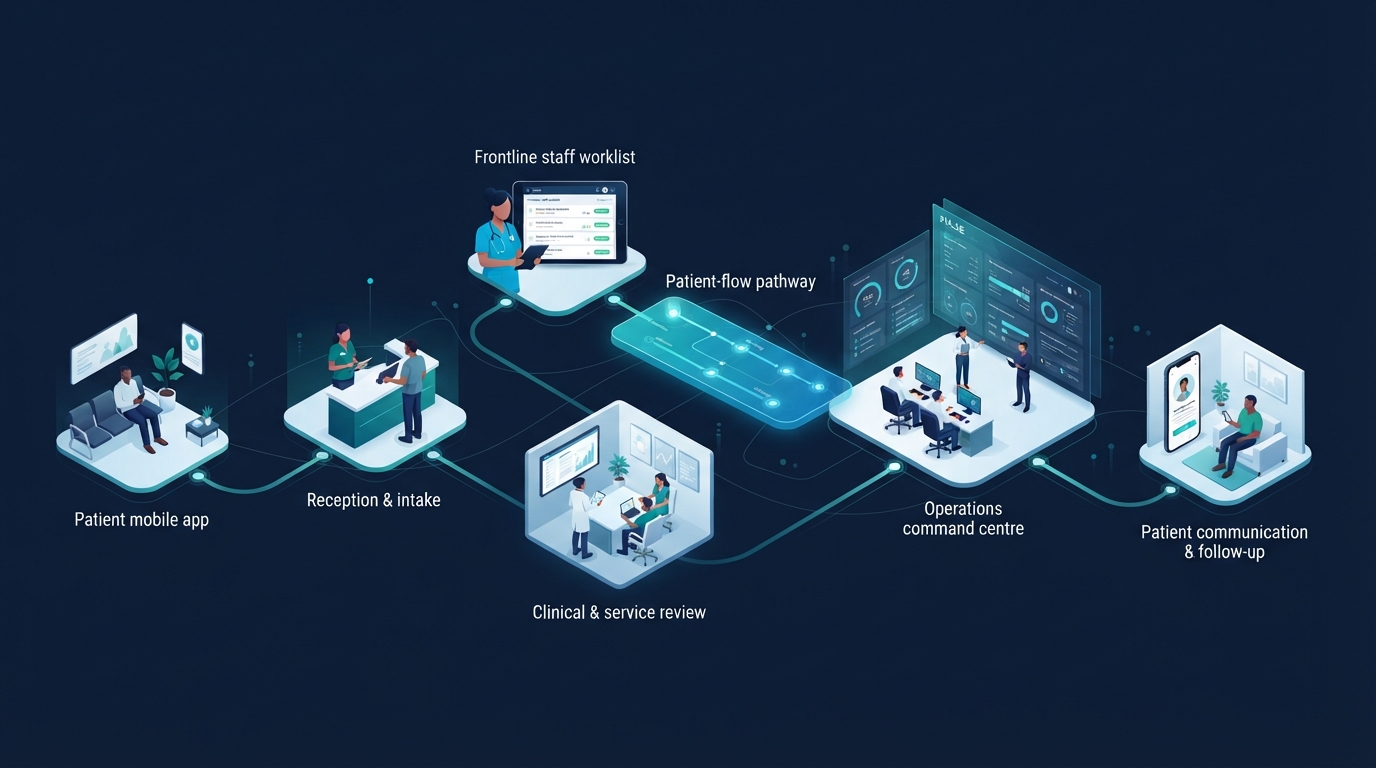
The patient journey is connected.
The systems around it often aren’t.
Healthcare organisations have invested in clinical, administrative and enterprise systems. Yet much of the work between those systems still depends on disconnected queues, manual hand-offs, repeated capture, phone calls, spreadsheets and staff knowing who to contact next. This creates an operational gap.
PULSE does not need to replace every existing healthcare system. It connects the operational work between them.
Traditional operating model
- Isolated queues
- Anonymous backlog
- Manual hand-offs
- Repeated status enquiries
- Retrospective reporting
- Site-specific operating tools
PULSE operating model
- Connected patient journey
- Owned operational work
- Closed-loop hand-offs
- Journey-linked communication
- Live operational visibility
- Reusable modular platform patterns
More than queue management. An operating layer for the patient journey.
One platform.
Five operational outcomes.
Patient Access
Digital, mobile, multilingual and assisted routes into care.
Patient Flow
Owned journeys, routing, service movement and closed-loop hand-offs.
Staff Coordination
Role-specific worklists, priorities, alerts and collaboration.
Operational Control
Live demand, capacity, wait risk, ageing work, exceptions and escalation.
Patient Engagement
Two-way communication, virtual waiting, reminders and follow-up.
Designed around the journey.
Not the queue number.
A patient may be waiting, but operationally something needs to happen. PULSE turns that requirement into an owned Work Item.
Alternative entry routes converge into one controlled journey
Access
Digital-first where possible. Assisted whenever needed.
Work Item lifecycle
Every important operational action can have an owner, state, priority, escalation path and evidence of completion.
One journey, from access to closed-loop completion.
Mobile or assisted access
The patient begins through an appropriate digital or assisted route.
Start with the problem that matters most.
Expand without rebuilding the platform.
PULSE Core
Shared journey, Work Item, workflow, event, evidence, identity, role and configuration foundation.
Foundational modules
PULSE Access
FoundationalDigital and assisted registration, arrival and access preparation.
Inclusive, consistent entry to services
PULSE Flow
FoundationalCoordinate journey states, routing, movement and hand-offs.
Owned, visible patient flow
PULSE Engage
FoundationalConnect communication to the patient journey.
Engaged, informed patients
PULSE Command
FoundationalLive operational visibility and intervention support.
Shared operational truth
Extension modules
PULSE Verify
OptionalControlled verification and exception workflows.
Owned exceptions
PULSE Resource
OptionalOperational resource and transfer coordination.
Closed-loop hand-offs
PULSE Navigate
GovernedControlled conversational and voice-supported interaction.
Structured intake
PULSE Insight
OptionalGoverned analytics, forecasting and decision support.
Decisions from evidence
PULSE Edge
Site-dependentApproved essential local functions and reconciliation.
Continuity where required
See the operation.
Not just the report.
PULSE Command gives operational teams and leadership a shared view of where demand is building, where work is ageing, where patients may be delayed and where intervention is needed.
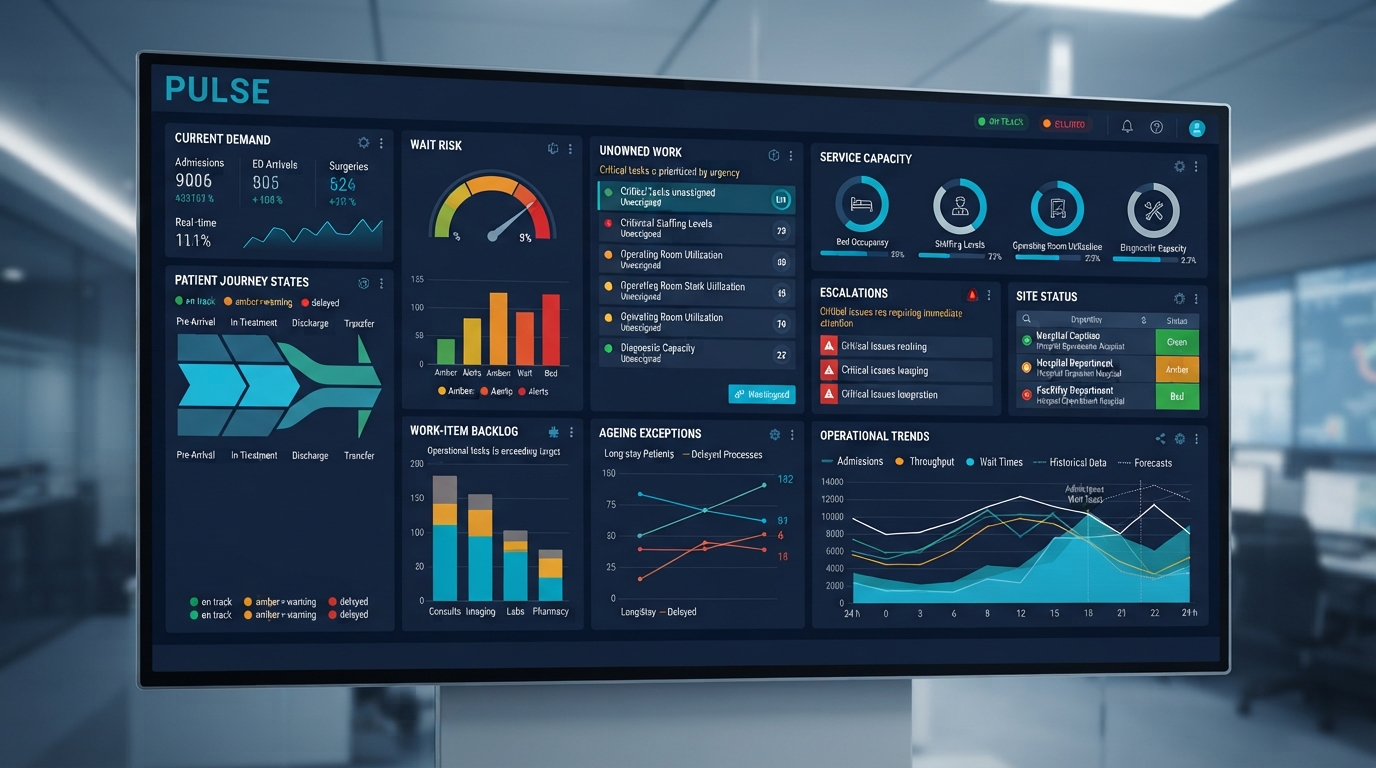
From the waiting room to the command centre.
Explore PULSE Command architectureStart at one facility.
Build for a health network.
Designed for public health systems, private hospital groups and individual healthcare facilities.
Reference Pilot
1 Site
First Wave
3–5 Sites
Regional Rollout
10–25 Sites
Large-Scale Deployment
25–50+ Sites
Later sites can reuse the platform capabilities, patterns and evidence built at the first site:
Build once. Configure repeatedly. Learn continuously.
VIEW IMPLEMENTATIONTrust is part of the architecture.
Trust is not a feature added at the end. It is part of the PULSE architecture, operating model and release process.
PULSE Journey (Pty) Ltd
Patients experience healthcare as one journey, even when the organisation delivering that care is divided across departments, queues, systems, channels and teams. PULSE brings the operational journey together.
PULSE is initially focused on South African healthcare environments across public health systems, private hospital groups and individual facilities. The platform is designed to remain internationally extensible.
The company’s purpose is to connect patient access, flow, staff coordination, operational control and engagement.
One patient journey. One operational truth.

What would one connected patient journey look like in your organisation?
Tell us where patients, staff or operations encounter friction today. We’ll start there.
 One patient journey. One operational truth.